Calensa Fry
Panic RoomCalensa Fry is a local seer and self-described practitioner of witchcraft whose influence rests on a mixture of ritual, reputation, and fear. She raised her grandchildren Wynsum Fry and Jory Fry after their mother deserted them, and became central to Maris Hemsley’s effort to understand the survival of folk belief in modern Cornwall. Maris’s account presents Calensa as a powerful presence, but leaves open whether her apparent supernatural influence is magic, psychological manipulation, or a force produced by the beliefs of those around her.
Identity and Local Reputation
When Maris first bought a cottage as a weekend retreat in the late 1970s, she began hearing about local people who sought Calensa’s help. The visitors were mostly farming families facing practical troubles: illness, miscarriage, money problems, sickness among livestock, or blight in a crop. Rather than turn to a doctor, accountant, or vet, they went to Calensa to predict the future or help resolve their difficulties. The range of these concerns made her more than a fortune-teller in the community’s eyes: she was a resource for problems that crossed the boundary between everyday misfortune and what people understood as supernatural harm.
Calensa was also regarded as a dewitcher, someone consulted by people who believed they had been cursed and who was thought able to remove a spell cast by another witch. Maris, a historian and anthropologist retired from Exeter University, was fascinated by how this form of witchcraft persisted into the twentieth century. She imagined it as the subject of an academic study, approaching Calensa first as a possible source for research rather than as a figure whose powers she accepted.
Maris’s Investigation and the Accidents
To gain access to Calensa, Maris invented a story that she was bewitched and suffering a sequence of inexplicable accidents. A local farmer’s wife introduced them. During their first meeting, Calensa asked Maris about her enemies and read cards. Maris remembered little of the session and suspected that more had happened than she could recall. At a later meeting she hid a tape recorder in her handbag, but again came away with scant memory; the recording contained only white noise.
Afterward, accidents began to resemble the ones Maris had invented as her cover story. Her car brakes failed; a heavy book fell from a high shelf and knocked her unconscious; and she slipped from the harbour wall at Mullion Cove into the sea, where an angler rescued her. Maris became convinced that Calensa had recognized the deception and punished her with a genuine spell. She burned the blank tapes and wrote to confess that she had sought material for a book, adding that she was abandoning the project.
Maris later described an apparent pattern in which her fear and susceptibility receded when she returned to Exeter, then returned when she came back to Cornwall. After she confessed to Calensa, the accidents stopped. Maris had a rational outlook and recognized that the supernatural explanation seemed absurd to it, but she did not regard the change as coincidence. Her account therefore establishes the force of her experience and its consequences without independently proving that Calensa caused the accidents.
Tredarvas Farm and the Fry-Harkness Feud
Maris continued meeting Calensa, though she came to regret accepting Calensa’s offer to help with her research. Calensa initially denied having supernatural powers, describing her practice instead as psychological manipulation that sustained her reputation and business. She maintained that people brought misfortune upon themselves. Maris interpreted this denial as a double bluff: Calensa seemed to challenge her to dismiss witchcraft even as Maris’s own experiences made that dismissal difficult.
After several unproductive meetings, Calensa suggested that she knew trade secrets she might disclose in return for a favor. She wanted Maris to accuse Jack Harkness in print of responsibility for Jory’s death. Maris could not fit such a serious, unsupported allegation into an academic study of witchcraft. Calensa, Maris observed, seemed to regard her simply as a writer who might give the family’s conviction a public record.
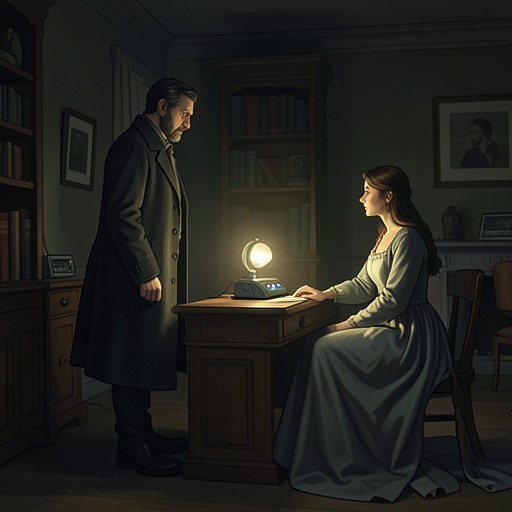
Their meetings took place in the kitchen of Calensa’s house at Tredarvas Farm. The farm itself had become a ruin; the Frys had left the land but remained in the house for a time. Calensa had married a cousin, also a Fry, who was dead by the period Maris described. Maris never saw beyond the kitchen, a restriction that gives the repeated visits a narrow, enclosed setting. Calensa did not visit Maris; Maris went to her.
Calensa traced the feud between the Fry and Harkness families back generations, telling Maris that they had stood on opposite sides in the Cornish rising of 1648. She insisted that Jack Harkness had held Jory face down in the rock pool where he was found until he drowned, on the morning of 1 August 1970, the day of Lammas. Calensa repeatedly emphasized the date and its significance, though Maris did not understand why the festival mattered. The allegation had no evidence beyond Wynsum’s account: sent to look for Jory when he failed to appear for breakfast, Wynsum said she saw Harkness cycling away up the hill towards Mullion as she approached the cove. That sighting was enough to sustain Calensa’s and Wynsum’s certainty, but not to verify the murder claim.
Influence and Narrative Role
Maris found Calensa intimidating even when she knew herself to be far from Cornwall. Calensa was in her sixties when they first met and lived well into her nineties; over time, Maris thought Wynsum increasingly resembled her grandmother. Calensa’s authority thus appears both personal and inherited: it operates through her own encounters with clients and through a family story in which old grievances remain active across generations.
The novel keeps the explanation of Calensa’s power unresolved. Her claim that misfortune is self-induced offers a rational account of her work, while the accidents, blank recordings, Maris’s fear, and the cessation of trouble after her confession give the supernatural interpretation emotional and narrative force. Her most consequential intervention is not a demonstrated spell but her insistence that Jory’s death belongs to a continuing family feud and that Jack Harkness must be named as his killer. Calensa’s remembered presence therefore links everyday consultations, contested belief, and an accusation whose conviction exceeds its evidence.